Recruitment pack: QAA Student Strategic Advisory Committee 2026-27
Publication date: 04 Jun 2026
The Student Strategic Advisory Committee (SSAC) is essential to QAA, providing invaluable advice and guidance based on the unique perspectives and expertise of its members, comprising students, student representatives, and staff from students’ unions or representative bodies in UK higher education.
QAA is dedicated to actively engaging students in its work. For the 2025-26 term, QAA aims to strategically use the expertise of SSAC members to set priorities for student engagement across the Agency.
We are recruiting for up to 11 new members to join us for the 2026-27 recruitment for our QAA Student Strategic Advisory Committee (SSAC).
For further information about the role please take a look at our recruitment pack. To express your interest in becoming a member please complete this short form (we do not accept CVs). The recruitment period will run between 09:00 on 5 June until 23:45 on 3 July. The terms of reference for the committee are available further down the page.
Publication date: 04 Jun 2026
For anyone considering getting involved, I say, definitely do so. You'll meet the greatest bunch of people. You'll get the absolute best support from the staff team to encourage you in engaging with work that drives you to want more from HE for all of us. Just watching the way that everyone here works to enable us to build something great, and to feed into sector wide discussions, in a way that makes you feel like you are doing something awesome. I want every student to feel that level of support and trust in their thoughts and ideas. I know I'm a much better person for spending these two years with SSAC.
Cinnomen McGuigan, The Open University, SSAC member 2024-26
Members of SSAC have various opportunities to get involved in QAA work, such as participating in groups focusing on key areas such as Generative AI, speaking at events, and leading discussions within QAA networks. The committee has significantly influenced national student-centred projects, introduced student reviewers to QAA review teams, and shaped QAA’s overall strategy and the development of the UK Quality Code.
The SSAC begins each year with an in-person induction. This event sets the priorities for the year, introduces members to QAA, and fosters networking opportunities. Throughout the year, the committee meets at least three times. These meetings are attended by QAA’s Chief Executive, Chair of the Board, and other Board members. During these sessions, the Chief Executive and Chair present reports on activity at QAA and board meetings, discussions are held on key topics and progress on priority areas. Members also provide feedback on the development of high-profile sector projects and guidance, along with developments in the higher education sector.
A valuable opportunity to collaborate with others, develop a deeper understanding of inclusive communication, and contribute to guidance that has real impact across higher education. I would definitely recommend getting involved, as it is a meaningful experience that helps you develop new skills while being part of work that is genuinely shaped by student voice.
Publication date: 13 Feb 2024
View the outputs and resources for each of the priorities below:
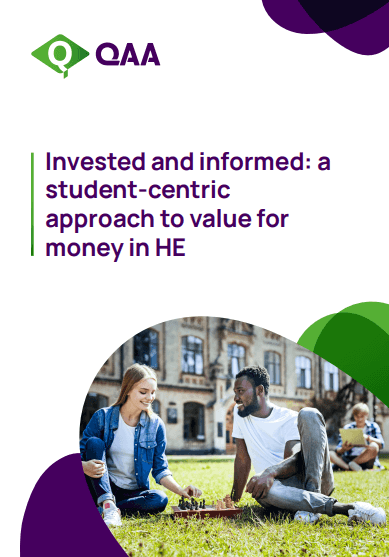
In the aftermath of the cost-of-living crisis, and with increasing concerns about the marketisation of the HE sector, students are increasingly reporting value for money as key in choosing an institution and programme of study. As SSAC, we want to discuss and then feed into QAA Board discussions about what value for money means in the context of quality assurance with the aim of influencing the agency’s thinking and work in this space.
Publication date: 25 Jul 2025
In response to sector trends (especially related to lower NSS results across HEIs in this category), as a committee we’re interested in discussing several things: first, how students are assessed on their understanding of their subject; second, how assessment is diversified to address different students' needs and preferences; third, what feedback should be to really help students improve. The outcomes of the discussions will then be fed back to the agency to shape sector best practice in this area.
Following discussion of this broad topic, student committee members identified a selection of practical resources they found particularly useful when advising peers on assessment and feedback.
The main goal of this priority area is to raise awareness of the accessibility of language and impact on the learning and wider experiences for students and learners across the UK tertiary education sector.
To achieve this, we gathered and collated student and student representative feedback via a Padlet and drew upon our own experiences of navigating the often-complex language used across tertiary education.
In this document we present our initial findings along with recommendations for providers driven by the student perspective. All voices presented here are authentic and we have only amended quotes where spelling or grammatical corrections needed to be made or if we have picked out a key element in the quotes.
Publication date: 29 Oct 2025

We are delighted to introduce the committee for 2025-26.
Master's Student
University College London
Vice President Higher Education
National Union of Students
Stakeholder
University College London
Student
Wrexham University
Student
The University of Edinburgh
Student
The University of Manchester