Skip to main content Accessibility Statement

QAA's new ‘state of the nation’ series has a singular ambition: to move the debate beyond the myths, headlines and binaries towards an evidence-based understanding of what is actually happening across the tertiary sector – and what this means for protecting quality and standards.


We’re looking at four key priority areas:


  • artificial intelligence
  • domestic franchising
  • what quality costs
  • how quality is measured.
""
These pieces bring together data, analysis and sector engagement to highlight emerging trends, challenges and opportunities and explore how policy, regulation and institutional practice can respond in a targeted, proportionate and effective way.

The perfect storm: AI, assessment and a sector under pressure

Three years on from the launch of ChatGPT, generative AI has moved from a sector preoccupation to a structural challenge for how higher education designs, delivers and assures assessment. Providers have done substantial work in response, but the picture remains uneven.


Drawing on staff roundtables, student focus groups, thematic analysis of external QAA review reports between 2023 and 2026, and existing data on student uptake, this report finds the central challenge is one of variability, in how students use GenAI, in staff confidence, in institutional policy, and in how policy is implemented across schools, modules and tutors. Where this becomes inconsistency for students on the same award, it puts at risk the conditions under which academic standards can be assured.

The report sets out what QAA will take forward in response, including an AI in Assessment Community of Practice, GenAI as a cross-cutting theme of our 2026-27 membership offer, the refresh of the Academic Integrity Charter, and continued funding through our Collaborative Enhancement Projects, alongside suggested actions for individual providers.


Key findings from the report

  • Student uptake is high, but not universal. According to the latest HEPI/Kortext survey, 95% of undergraduates use GenAI in some form, 94% for assessed work, but a meaningful minority remain non-users, with uptake shaped by discipline, ethics and access.
  • The sector has acted, but practice is uneven. Variability runs deeper than institutional differences, it runs through schools, modules and individual tutors within the same institution.
  • Inconsistent practice is undermining policy across the sector. Students experience the unevenness of implementation before they experience the policy itself, encountering different rules within a single programme of study.
  • Detection tools are losing credibility. AI detection tools have been progressively withdrawn or downgraded, with concerns about reliability, bias against international and EAL students, and false positives. The direction of travel is towards assessment design that doesn't depend on detection.
  • Trust is the underlying issue, and it's eroding. Students cannot reliably predict how policies will be applied from one module to the next. Staff are increasingly uncertain about their ability to judge AI use. Where trust breaks down, the assessment relationship that underpins academic standards becomes harder to sustain.
  • Equity risks and a gap in training. International, students for whom English is a second language and neurodivergent students are disproportionately affected by inconsistent implementation. Training was the single strongest ask, not only on how to use GenAI, but on how to use it well.
  • The sector wants support, not regulation. No appetite for formal regulation. The strongest ask was for forums, practice-sharing, and principles-based framing.


Is growth outpacing quality? The changing shape of franchised higher education

The debate on franchising is no longer new – but it is only recently that the data has enabled us to look beyond the headlines and identify the areas of greatest risk.


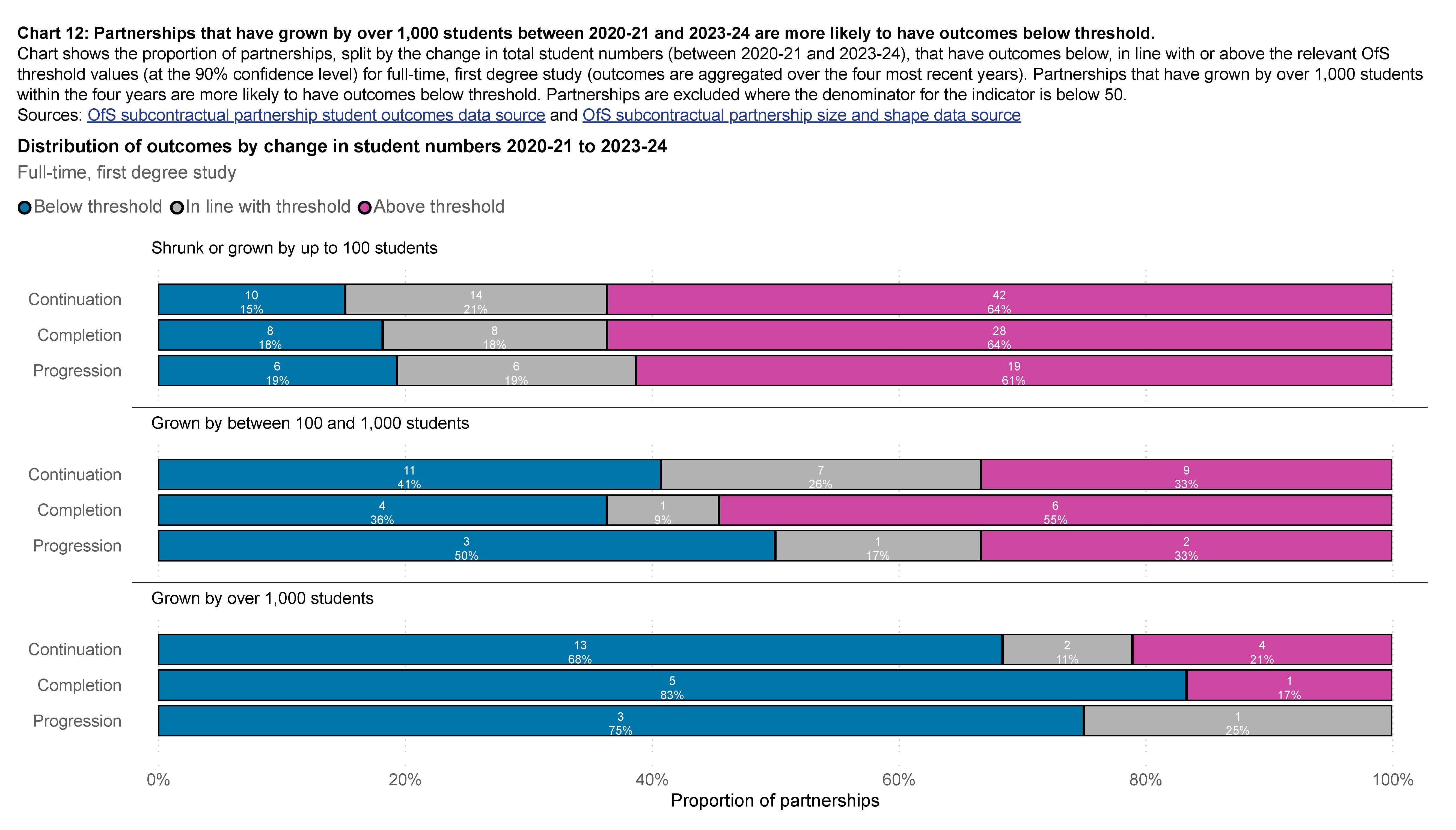
This data, alongside intelligence gathered through QAA’s review and sector engagement activity, demonstrate that franchising is not inherently risky; rapid, unmanaged growth is.


This is the first comprehensive analysis of the Office for Students’ dataset, enabling findings to be substantiated with quantitative data for the first time.


Key charts from the report

All charts featured in the report are available to browse below. These are interactive – hover over elements in the charts to view more information about specific data points. Click on the double-headed diagonal arrow in the bottom-right corner to go into full-screen mode and view larger versions of the charts.


All data visualisations included in the report are available to download individually for use in presentations, briefings and internal discussions to support sharing insights and evidence. Download links are available alongside the caption for each chart within the report.


We've featured three of the key charts below which you can download:


Click on the chart to download the image.


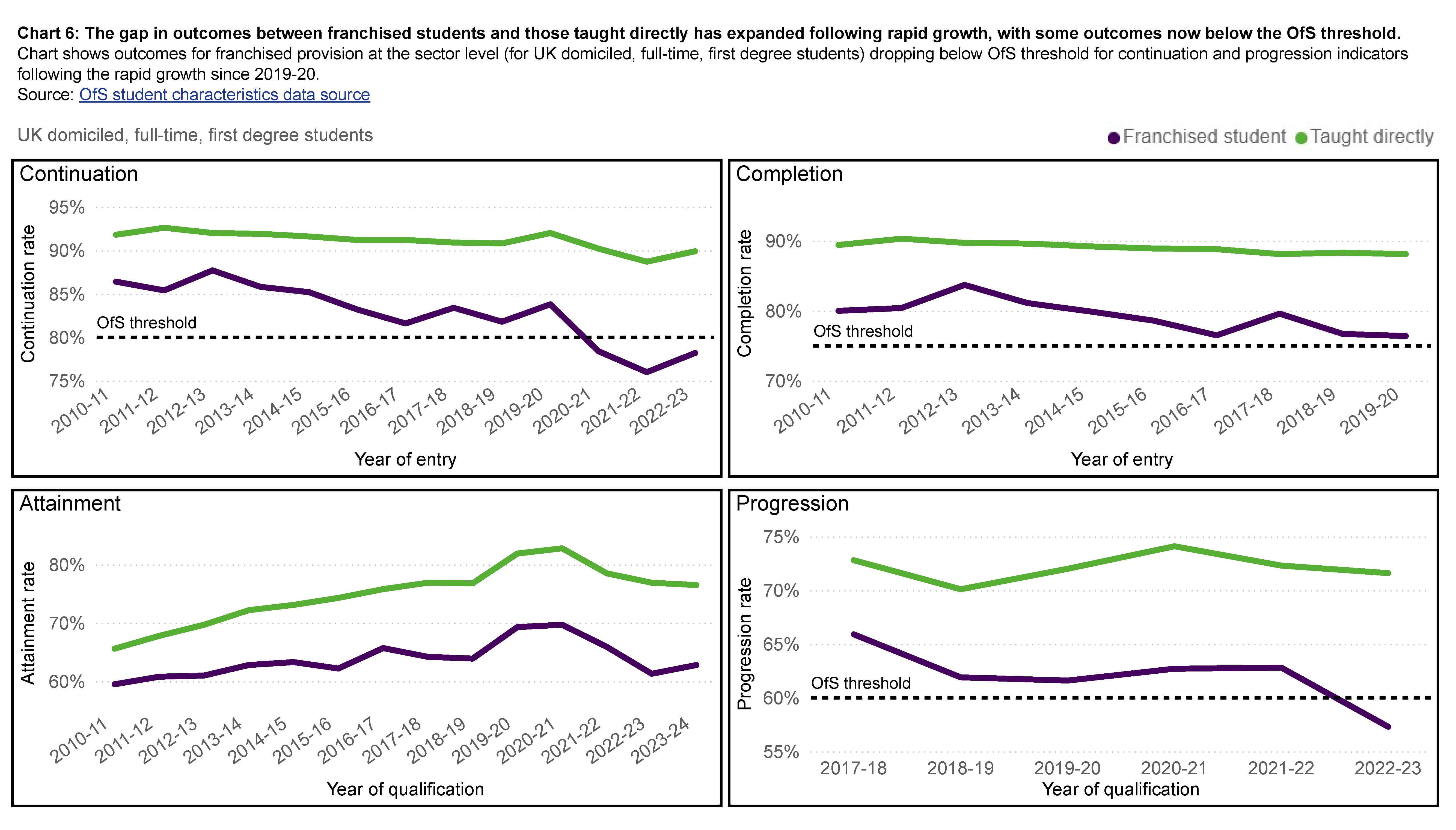
Outcomes for franchised students and those taught directly

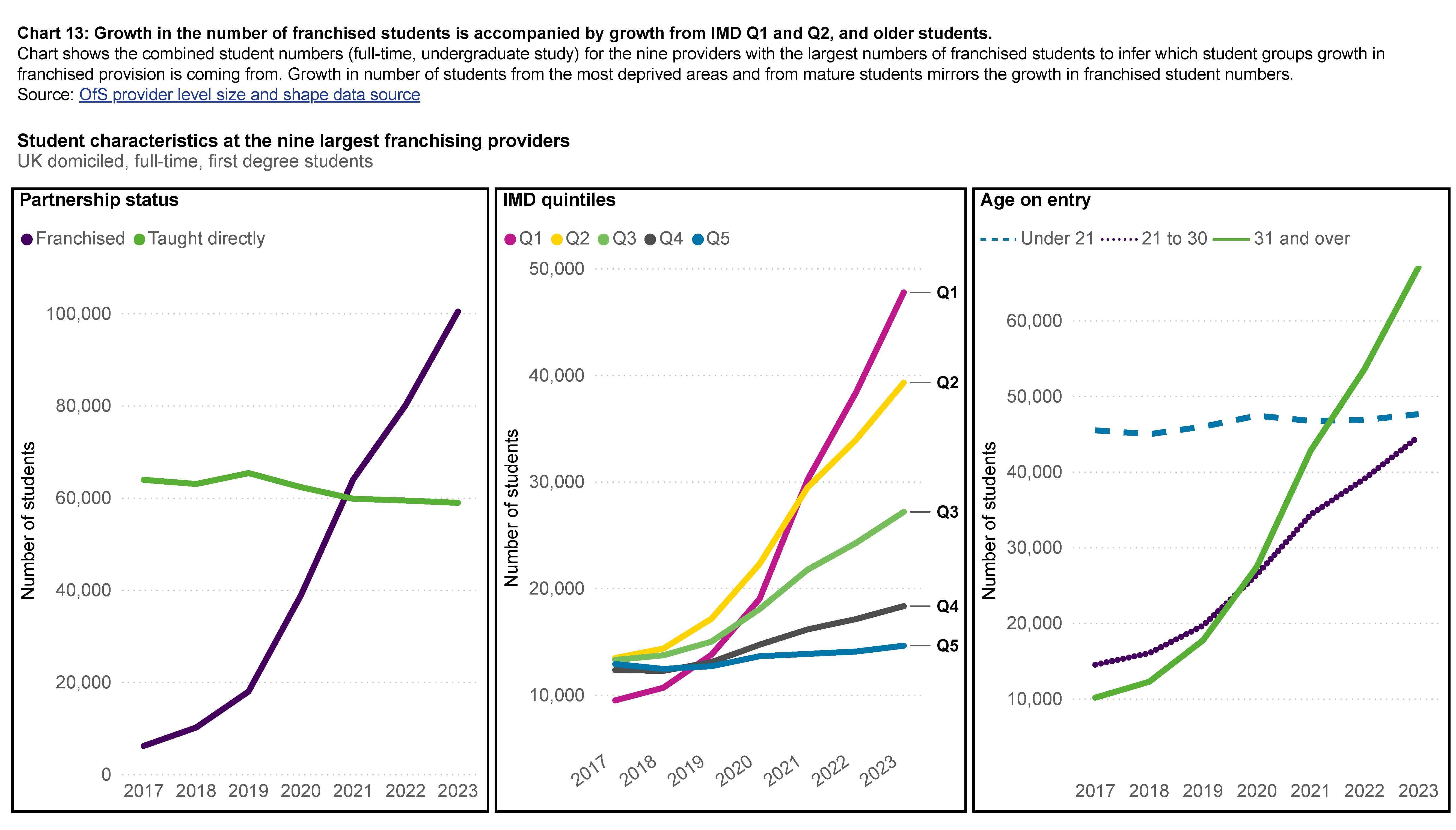
Student characteristics at the nine largest franchising providers

Distribution of partnership outcomes by change in student numbers

Further support for QAA members

Policy Matters: Meeting OfS Condition E10

This resource is the first in a new series for QAA members in England to support you in meeting your regulatory requirements. In this guidance, we focus specifically on the need for providers to develop a subcontracting information source, and the considerations that a provider will need to give to its preparation and publication.


Case study: Buckinghamshire New University’s approach to subcontractual arrangements

This case study outlines how Buckinghamshire New University has undertaken a fundamental programme of reform to strengthen how it oversees, governs and supports its subcontractual partnerships to develop a more robust, risk‑based framework that reinforces academic quality, regulatory compliance and accountability across the partnership portfolio.