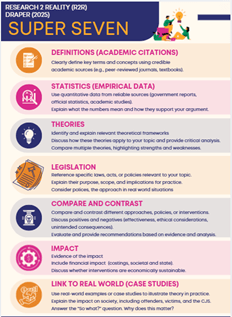
The Super Seven Academic Competency Framework (Draper, 2025)
Publication date: 28 Apr 2026

Chrissie Draper
Higher Education Advanced Teacher Practitioner, Derby College
Behind every student entering College-based higher education (CBHE) is a story, most often one of resilience, disadvantage, or being the first in their family to take this step. With this, it is clear CBHE faces many challenges, but its widening participation mission gives a unique power to redesign learning around real students, real lives, and real change.
Why does this matter? The Department for Education (2025) reveals participation measures highlight long‑standing gaps in higher education entry, a key point highlighting progression is strongly shaped by region, prior attainment, and school/college background. Furthermore, students from widening participation routes, have distinct transition needs (QAA, 2026).
Recent data show that although undergraduate acceptances increased in 2025, overall sector growth continues to fall short of projected levels (Validated Insights, 2025). Meanwhile, UCAS figures indicate that improvements for disadvantaged applicants have not eliminated longer‑term inequalities in access (UCAS, 2025).
Within CBHE, it has become increasingly important to open up conversations about the complex learning barriers that influence student performance. One of the most significant and recurring challenges highlighted is the level of anxiety that manifests in the classroom, often shaping how students engage, participate, and ultimately achieve. The Cycle of Collaborative Observation (CoCo) project was driven by the need to understand these experiences more deeply.
In CBHE, both staff and students can often feel overwhelmed by endless frameworks, models, and expectations. But the Super Seven has been designed to offer something refreshingly simple: seven clear, actionable principles that instantly strengthens teaching and learning in the HE classroom.
The Super Seven offers a simple yet powerful recipe for stronger assessment writing. By embedding definitions, empirical data, legislation, theory, compare and contrast, impact, and real-world application into teaching, students develop the skills to write analytically and critically. This structured approach not only enhanced academic performance but also supports equitable learning opportunities for all students.
Publication date: 28 Apr 2026
Building on insights from CoCO cycle one, it became evident just how strongly anxiety is linked to summative assessment. The observations revealed patterns that could no longer be ignored, underscoring the need for a focused approach to supporting students more effectively.
Derby College’s Level 5 Criminal Justice students and staff have just wrapped up their second Cycle of collaborative Observation. This cycle, in particular, showcased just how powerful true collaborative learning can be.

In the second CoCO cycle, this came to life as staff and students worked together to tackle one of the biggest challenges at Level 5 in developing confidence in critical academic writing. The Super Seven, seven simple steps, but one powerful shift. Taking centre stage, with a clear scaffolded approach for academic writing, students structured arguments and began to integrate evidence.
Firstly, through a structured writing workshop, secondly, the Super Seven entwined into two teaching sessions linked directly to the curriculum.
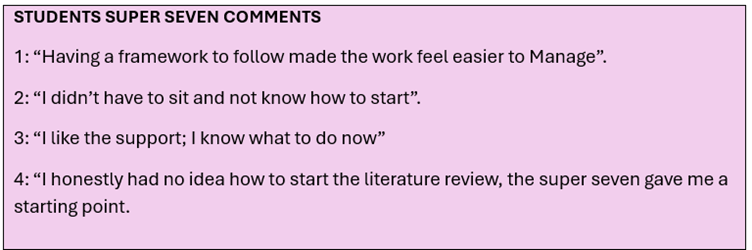
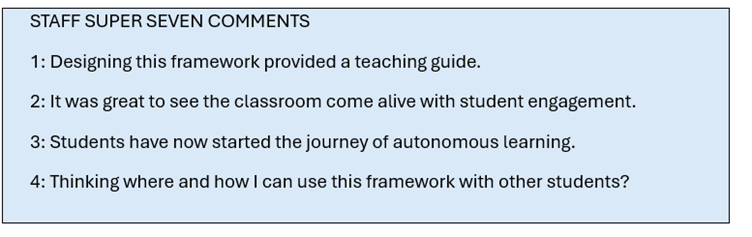
The final observation pushed this even further with a Dragon’s Den‑style pitch challenge. Students used the Super Seven approach to present research‑informed arguments, justify their decisions, and demonstrate real‑world application. This dynamic finale showcased not only their growing academic confidence but also the power of collaborative learning to turn frameworks into lived, authentic practice.
On reflection, CoCO cycle two has brought to life that the Super Seven is particularly effective for students from widening participation backgrounds because it provides a clear, repeatable structure for academic writing. Each element acts as a building block, guiding students through the process of constructing evidence-based arguments.
By exposing academic expectations and offering a scaffolded approach, the framework promotes confidence, inclusivity, and academic success. Furthermore, the finale pitch has proven to be a powerful teaching tool, with an active classroom where students openly presented their research, packed with critical thinking which unfolded in real time.
The most significant outcome of the Level 5 Dragon’s Den pitch was the clear demonstration of students’ ability to gather evidence for a research‑based assessment. They effectively collated their data and communicated their findings to an audience with growing academic confidence. However, there was limited evidence of students being able to articulate the relevance of their research within the context of their pitch, indicating that further support is needed to strengthen this element of academic competency.
One final note, when the higher education classroom is prepared to consider merging creativity with academic rigour, learning becomes more than an assessment but is strengthened with real world application with academic competency, even for those students who may not have naturally succeeded.
References
Department for Education (2025) Widening participation in higher education: 2025. Available at: https://www.gov.uk/government/statistics/widening-participation-in-higher-education-2025 (Accessed 12th March 2026).
QAA (2026) Access to HE Statistics. Available at: https://www.qaa.ac.uk/access-to-he/about-access-to-he/access-to-he-statistics (Accessed 12th March 2026).
UCAS (2025) UCAS releases undergraduate January equal consideration applicant data for 2025. Available at: https://www.ucas.com/corporate/news-and-key-documents/news/ucas-releases-undergraduate-january-equal-consideration-applicant-data-2025 (Accessed 9 March 2026).
Validated Insights (2025) Higher Ed Insights August 2025. Available at: https://www.validatedinsights.com/wp-content/uploads/2025/08/Higher-Ed-Insights-August-2025-v1.0-1.pdf (Accessed 9 March 2026).