
Is flexibility in higher education just a matter of convenience? A critical literature review
Publication date: 20 Jun 2025
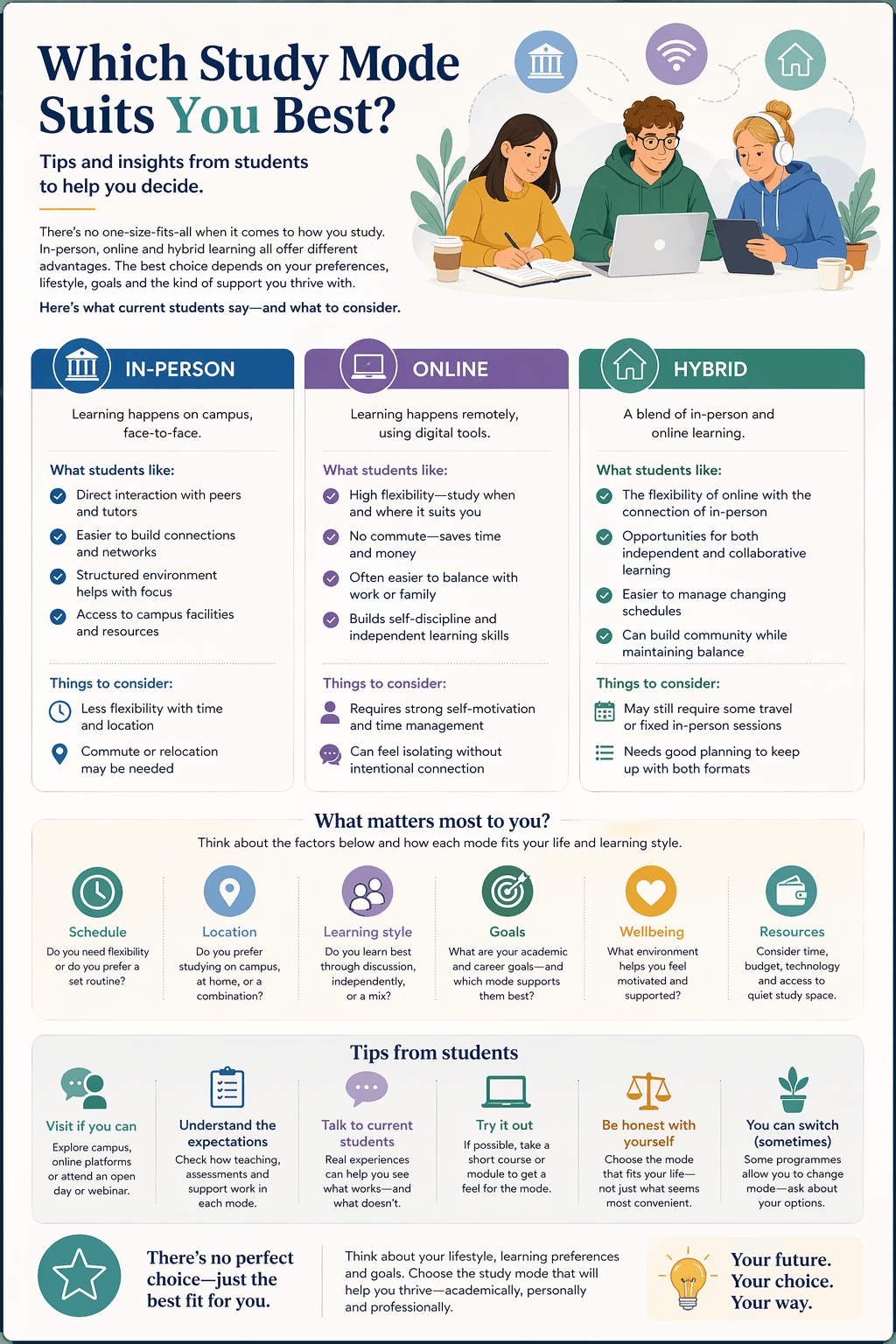
This collaborative enhancement project focused on student experiences in courses which are offered as identical programmes, only varying in terms of the study mode. Flexible learning is often framed as a choice between traditional on-campus learning and alternative online modes of study. Some providers offer hybrid modes of study which are designed to operate somewhere along the dimensions of flexibility in time and place.
Our research with students experiencing a variety of study modes indicated that traditional study modes characterised by on-campus learning space, fixed timetables and physical proximity of learners and tutors are perceived as different from online and hybrid study modes in more than degrees of flexibility of learning space and timing of learning activity.

We worked closely with four student co-producers to create a toolkit of resources for institutions and students who are considering alternative study modes. Our aim was to facilitate informed decision making and communication about different study modes.
The team has completed a literature review exploring preferences, learning outcomes, student characteristics, and measures of success across different modes of study in higher education, with a particular focus on Psychology courses.
Publication date: 20 Jun 2025
Although study mode choice is frequently understood as a question of lifestyle fit and convenience, there are differences between on campus and online study modes which students should be aware of before committing. Space and time are only two of several important dimensions differentiating traditional and flexible study modes.
Additional dimensions include:
Whilst institutions may offer hybrid and online programmes operating somewhere along these dimensions to reflect best pedagogical practice, true flexibility can only be achieved through a trade-off with interactivity. This is not necessarily well understood by prospective students. They frequently identified misconceptions and unrealistic expectations about:
We conducted survey and focus group studies to reveal the information students would have liked to have known before they embarked on their flexible learning programme. This is considered useful information for all students on all programmes as they directly address the questions students have before they commit to a course. However, online and flexible learning programmes are particularly prone to incorrect prior assumptions, especially where students have experienced traditional on-campus study previously.
Publication date: 28 May 2026
Publication date: 28 May 2026
Publication date: 28 May 2026
Publication date: 28 May 2026

Prospective students should be encouraged to engage with the pros and cons of different study modes, especially where a choice is offered by the provider. There are a number of relevant extraneous factors and student characteristics which are associated with success in flexible learning environments (see literature review for a fuller picture). Students need to be able to understand and evaluate the critical differences between traditional and flexible study modes in order to make informed decisions. The resources presented here are designed to be used by institutions to facilitate active engagement with different study modes during the recruitment process.

Lead institution: University of Roehampton
Partner institution: University of Liverpool
QAA supports a number of projects every year, covering a range of topics and interest areas. Each is led by a QAA Member, working in collaboration with other members institutions. You can find more information on all projects, and access resources and outputs, on our website.