Why assessment in the AI age doesn't have to go the way of the dinosaurs
Authors
Professor Mark J.P. Kerrigan
Director of the SOAS Academy of Learning and Teaching (SALT) and Professor of Educational Innovation and Futures, School of Oriental and African Studies, University of London
Dr Sian Lindsay
Academic Developer, University of Reading
Sarah Sherman
Director, The Bloomsbury Learning Exchange
There’s that well-known phrase that goes something like - ‘just because we can do something, doesn’t mean we should’. Mark wanted to know its origins, so he turned to Google for the answer and was rapidly bombarded with AI responses all trying to be helpful. After scrolling past all the AI noise, he finally found something real to reference - a quote from the 1993 movie Jurassic Park directed by Steven Spielberg. Actor Jeff Goldblum plays a sceptical scientist, who famously quips “Yeah but your scientists were so preoccupied with whether they could, they didn’t stop to think if they should”. Whilst we’re not trying to suggest that the explosion of AI into our lives poses exactly the same existential threat as bringing dinosaurs back from extinction(!), we have had to change and evolve the way we do things significantly and rapidly, with very little time to prepare or reflect. AI is everywhere, it can be wonderfully helpful, providing access to knowledge, but it can also really confuse things.
AI has challenged all industries and sectors, and its impact on education – in particular assessment – has been a growing concern. AI has intensified long-standing challenges and has introduced some new ones. We know that colleagues involved in the design, delivery and marking of assessments seek guidance and practical support in this space. Many (including us) would love to know how we can start it all again - design assessments that are inclusive, uphold academic standards, develop attributes that employers want and assure learning in the AI era. Unfortunately, there is no magic bullet that can address all these aspects perfectly at once, and compromises may be necessary (Corbin et al., 2025). To address this concern, SOAS is leading a QAA Collaborative Enhancement Project with six other HE institutions and the Bloomsbury Learning Exchange (BLE) to pilot, evaluate, and refine a practical Assessment Toolkit that supports educators in designing secure, inclusive, AI-aware, and future-focused assessment (Figure 1).
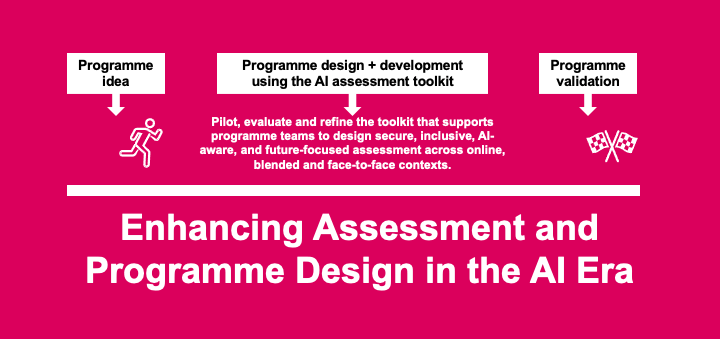
Figure 1: Overview of the project
The project recognises that generative AI represents a “wicked problem” for HE: complex, evolving and never definitively solvable (Corbin et al., 2025). As TEQSA (2025) argues, assessment reform must move beyond detection toward programme-level assurance of learning through coherent, evidence- informed assessment systems. The Assessment Toolkit operationalises this by providing structured workflows and information that help programme teams secure learning strategically, rather than reactively. The project advances existing practice by bridging the gap between quality, policy and day-to-day curriculum work. Our final project outputs will include a refined toolkit, practical resources and case studies.
In this blog post, we thought it would be useful to share what the current version of the toolkit looks like. The original toolkit at SOAS University of London is a series of interlinked PowerPoint slide decks which include (1) a Home Deck, (2) a Companion Deck and (3) six slide decks spanning different top-level assessment approaches underpinned by specific examples (Table 1). The Home Deck comprises information and general instructions, and the Companion Deck provides information on feedback approaches based on the size of the student cohort.
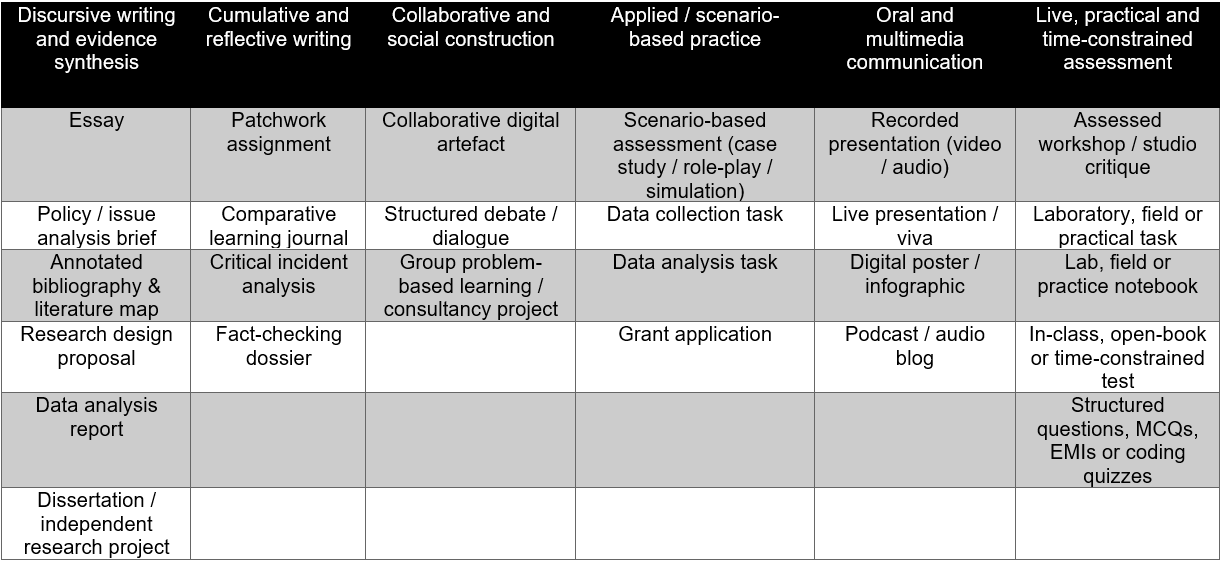
Table 1: Assessment types included in the toolkit, grouped into six broad approaches
For each assessment type, the toolkit brings together analyses and practical resources to support its selection, design and use (Figure 2). These provide a conversation starter for educators and programme teams to review existing assessments, explore alternatives and discuss what will work in their context. The analyses help users consider alignment with learning outcomes and examine strengths and limitations from student, educator and generative AI perspectives. Example assignment briefs, rubrics, formative checkpoints and feedback ideas offer starting points for adaptation. They also prompt discussion about expectations for GenAI use and opportunities to develop AI literacy and relevant graduate attributes. In doing so, the toolkit responds to growing calls to rebalance assessment, giving greater attention to the processes of learning alongside the final product. It encourages educators to consider how students’ developing understanding, judgements, responses to feedback and reflections can become more visible and valued within assessment.
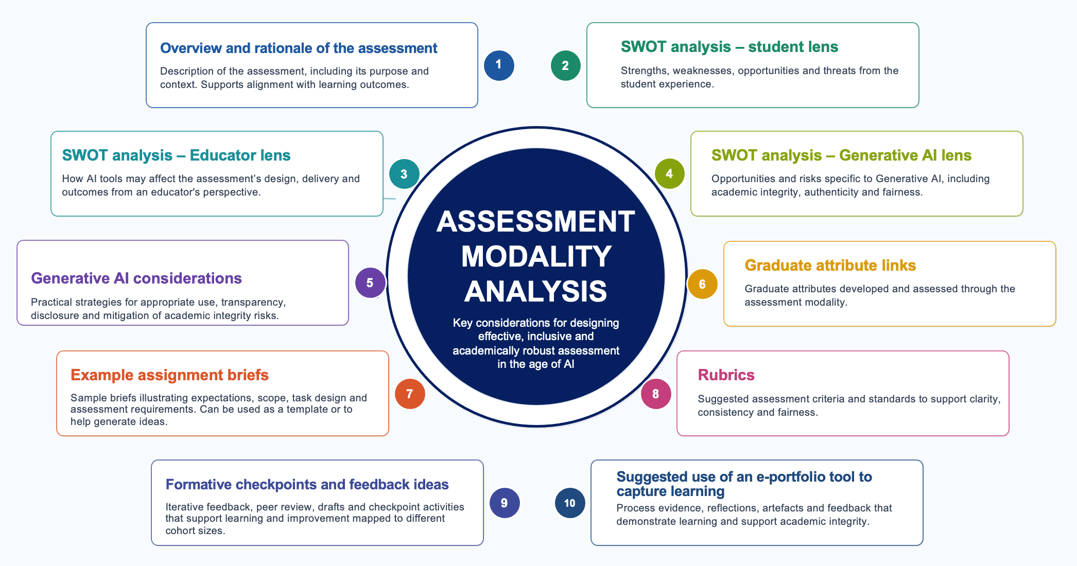
Figure 2: Analysis for each assessment modality
So, what have we been doing since the project started earlier this year? We have completed the project setup, created and shared a version of the toolkit with all our partners, and are recruiting programme and module teams to take part in the pilot. We have applied for and received ethical approval to conduct questionnaires and focus groups with participants, which will help us understand their experiences of the toolkit and inform future refinements before we share it at the end of the project. We have also presented our work at the SOAS Learning & Teaching Conference and the recent QAA online roadshow. We’ve been busy!
Over the next few months, we will continue recruiting new participants and begin piloting and evaluating the toolkit - we’ll keep you updated on how we are getting along.
References
Corbin, T., Bearman, M., Boud, D., & Dawson, P. (2025). The wicked problem of AI and assessment. Assessment & Evaluation in Higher Education, 1–17. https://doi.org/10.1080/02602938.2025.2553340 [Accessed 5 October 2026].
Tertiary Education Quality and Standards Agency (TEQSA), 2025.
Enacting assessment reform in a time of artificial intelligence. Canberra:
TEQSA. Available at: https://www.teqsa.gov.au/sites/default/files/2026-06/enacting-assessment-reform-in-a-time-of-artificial-intelligence-web.pdf [Accessed 5 October 2026].