Inclusive practices that support international students: an expanded guide for staff

Introduction
This resource brings together practical teaching strategies for staff working with international students in UK higher education. It has been developed and expanded through cross-institutional workshops at De Montfort University, the University of Manchester, Manchester Metropolitan University, and the University of Wolverhampton, as part of a QAA-funded Collaborative Enhancement Project.
The project team that led the development of this resource included Dr Sumeya Loonat, Wendy Ramku, Professor Richard Hall, Dr Hardeep Basra (De Montfort University), Dr Sylvie Lomer (University of Manchester), Dr Araida Hidalgo-Bastida, Professor Karen Pashby, Dr Gladson Chikwa (Manchester Metropolitan University), and Julie Hughes (University of Wolverhampton).
It draws on the Pedagogies of Internationalisation work by Sylvie Lomer, Parise Carmichael-Murphy, and Jenna Mittelmeier (2021). The reflexivity practices in this resource are particularly informed by the Ethical Global Issues Pedagogy framework co-developed by Karen Pashby at Manchester Metropolitan University.
How to use this resource
This resource is a companion to the project's Conceptual Framework and Deficit Narrative Audit Tool. It can be used independently, but readers who have engaged with the framework will find the practices more meaningful. The principles of practice from the framework are included below.
Practices are organised into five sections. The first addresses induction and arrival as a precondition for all that follows. The remaining four correspond to the four analytical lenses of the project's conceptual framework. Each section can be used independently.
The following information is provided for each practice:
- Why this is inclusive - the rationale grounded in the framework's commitment to moving from deficit to expansive thinking
- How to do it - practical suggestions for implementation
- Reflexive prompts - questions for examining your own assumptions, positionality, or institutional context
- From the workshops - a brief note grounding the practice in what was actually said or done at one of the four institutions
These practices are not prescriptions. A recurring insight from all four workshops was that good practice for international students is good practice for all. The reflexive prompts are as important as the practical suggestions. Without the habit of examining our own assumptions, inclusive practices risk becoming gestures rather than genuine shifts in how we position students in relation to knowledge and pedagogy.
Principles of practice
The following principles distil the project's framework into actionable commitments. They are intended as a shared language for staff development, curriculum review, and institutional policy, applicable across all four partner institutions and beyond.
1. Recognise before you teach
Before any pedagogic encounter, recognise who is in the room. Recognise them as individuals with histories, knowledge, and perspectives, not as a category defined by fee status or visa type. Belonging begins with recognition.
2. Locate the deficit honestly
When a student appears to struggle, ask where the deficit actually lies. In the student? In the curriculum? In the assessment design? In the support available? In the assumptions the educator brings? Honest diagnosis is the precondition for honest intervention.
3. Centre the voices of international students
Co-creation is not a methodology. It is an ethical commitment to working with students rather than on their behalf. Decisions about curriculum, pedagogy, and support should be informed by the actual experiences of the students they are intended to serve. What opportunities do international students have to share their stories?
4. Act where you can, and name what constrains you
Inclusive practice requires both individual commitment and institutional change. When workload, class sizes, or institutional policy make it harder to support international students well, name this as a structural issue rather than a personal failing and continue to act within whatever space you have. Educators who care about this work are not absolved of responsibility by structural constraints, but they are also not responsible for carrying institutional obligations through personal commitment alone.
5. Hold the ethical obligation from the moment of recruitment
The duty of care towards international students does not begin at induction. It begins when recruitment promises are made. Institutions that recruit internationally carry an ethical obligation to resource the conditions in which students can genuinely thrive and succeed.
6. Move from deficit to expansive
The goal is not to fix international students. It is to expand the pedagogic imagination of institutions and educators. See what international students bring rather than what they lack, and to build the structures that allow those contributions to be recognised and valued.
Induction and arrival: Belonging as precondition
Students must feel safe, seen and valued before they can contribute. The practices in this section address the period before and during week one.
Across all four workshops, the period of arrival and early induction was consistently identified as the most critical and most neglected phase of international student support. Students absorbing simultaneous shocks, cultural, linguistic, financial, and political, cannot engage critically or contribute academically until they feel genuinely welcomed and recognised. These practices are not supplementary to pedagogy. They are its precondition.
Why this is inclusive
Creative, low-stakes activities help students articulate their experiences of arrival before academic pressure builds. They communicate that the institution is curious about students as people, not just as learners.
How to do it
Give students a template, pens, and images and ask them to create a zine or collage representing their experience of arriving. Use this to open a discussion about expectations, shocks, and what support they need. Can be used in induction or week one.
Reflective prompts
What do you know about what your students experienced in their first two weeks? When did you last ask, and how did you ask it?
From the workshops
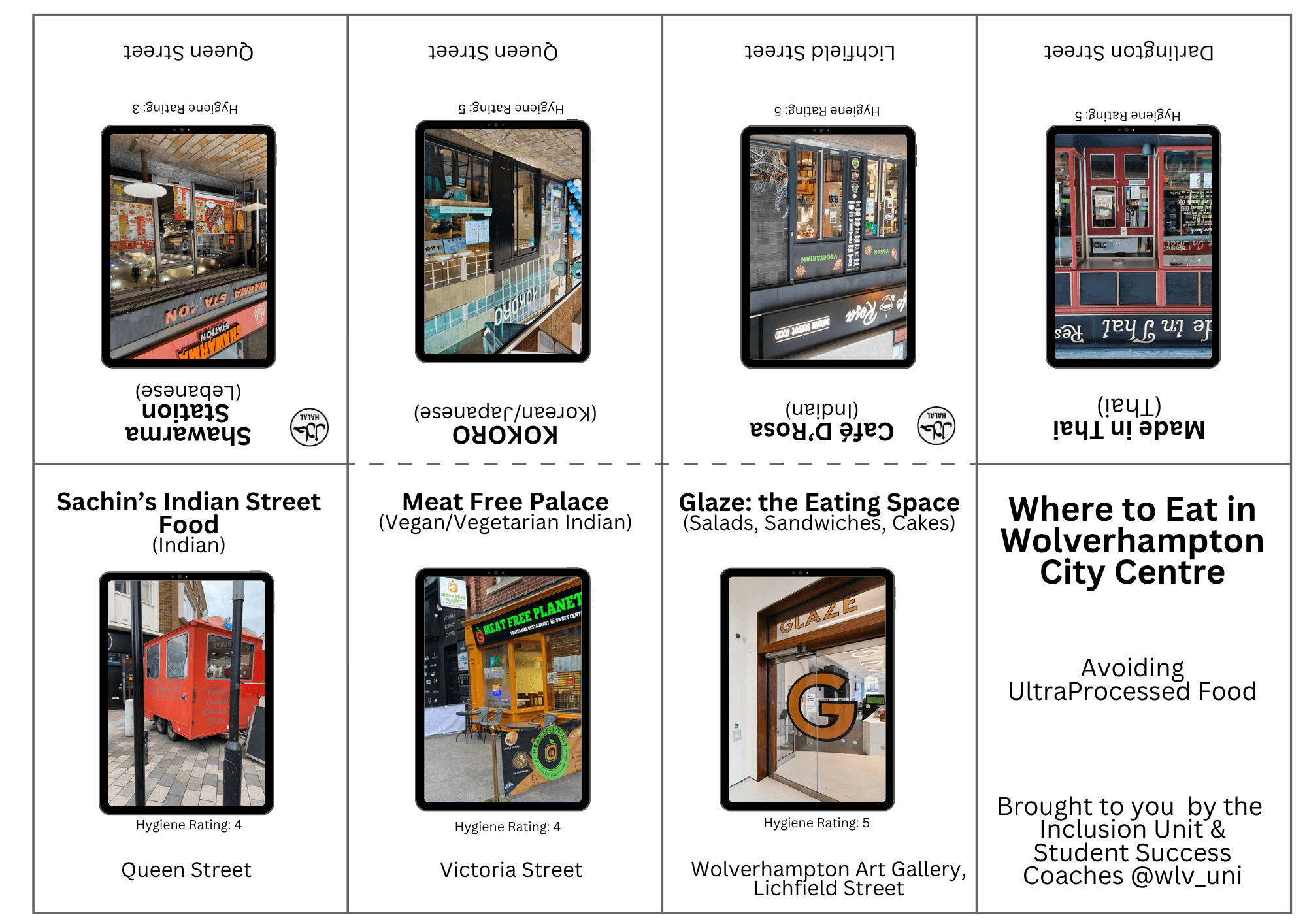
This practice has been used at the University of Wolverhampton, where four zines were created mapping arrival shocks including transport, accents, loneliness, finances, and food. One zine became a guide on where to eat in the city centre (see below).
Why this is inclusive
Mood boards allow students to express what they hoped for, what surprised them, and what they need, in a visual and accessible format that does not rely solely on written or spoken English.
How to do it
Ask students to create a mood board in the first week representing their expectations of studying in the UK and their experience so far. Use these as a basis for discussion and to inform your teaching approach for that cohort.
Reflective prompts
What assumptions did you hold about this cohort before they arrived? How close were those assumptions to what you discovered when you asked students directly.
From the workshops
This practice was suggested at the DMU workshop as a creative induction tool to help students articulate their experience and expectations before block teaching assessment pressure begins.
Why this is inclusive
Students arriving from different educational traditions may never have experienced a UK seminar format. Explaining what is expected of them in each type of session reduces the hidden curriculum and prevents the misreading of silence or passivity as disengagement.
How to do it
In the first session, explain each teaching format explicitly: what it is, what students are expected to do, and why. Do not assume that participation norms are universal. Acknowledge that different traditions expect different things.
Reflective prompts
What teaching format assumptions are embedded in your sessions that you have never made explicit? What would a student from a lecture-only tradition make of your first seminar?
From the workshops
This practice was raised at the University of Wolverhampton workshop where participants identified that students are unfamiliar with teaching styles other than lectures, and that explaining formats explicitly from day one helps students engage with confidence.
Why this is inclusive
The first week of teaching is critical and often compressed. Community building activities front-loaded into this period are more effective than those offered later in the term when students are already under assessment pressure.
How to do it
Build structured community-forming activities into week one. Use icebreakers that reveal individuals rather than reinforce national categories. Create space for students to meet peers from different backgrounds. Do not rely on assessment preparation to generate cohort bonding.
Reflective prompts
Does your week one teaching design assume that belonging will develop naturally alongside academic work? What would you remove or delay to create space for community building in the first week?
From the workshops
This practice was consistently raised across all four institutions. At the University of Manchester, community building was named as fundamental to preventing mental health issues and isolation, and the workshop highlighted that home and international students rarely interact, meaning genuine community rarely forms. At DMU, week one was described as the most important moment for staff to develop cultural consciousness.
Why this is inclusive
Peer support from students who have navigated the same shocks creates an immediately credible and accessible form of welcome. Students trust peers who have lived experience of arrival more than they trust institutional information.
How to do it
Establish a staffed welcome space in the first weeks of each intake, open every day. Staff it with international student ambassadors who can offer practical guidance on navigating the institution and the city. Ensure it is open for both September and January starts.
Reflective prompts
What does your institution currently offer in the first six weeks that is specifically designed for international students? Who staffs it, and do those staff have lived experience of international student arrival?
From the workshops
Wolverhampton's Welcome Hub was staffed by international student ambassadors and open every day for the first six weeks of term for both intakes. The chaplaincy also offered a weekly free Global Lunch every Tuesday as an informal belonging space.
Why this is inclusive
Leaving support for international students to individual academic goodwill is an ethical and structural failure. A dedicated role with time, expertise, and faculty embeddedness signals institutional commitment and provides consistent, specialist support.
How to do it
Where International Student Lecturer roles or equivalent exist at your institution, seek to collaborate with them throughout the year. Their specialist knowledge of international student transitions and support is particularly valuable during inductions and the first weeks of teaching when students are absorbing the most simultaneous pressures. If these roles do not exist at your institution, consider advocating for them.
Reflective prompts
What does your institution's support for international students rely on? Is it individual goodwill, voluntary attendance at optional workshops, or structurally resourced and embedded provision? What would you advocate for if given the opportunity?
From the workshops
The International Student Lecturer role at DMU was cited in the workshop as a model of good practice that sets DMU apart from other institutions. It combines academic skills support with pastoral guidance and is embedded within faculty rather than centralised.
Lens 1: Positioning
Who is the student in this encounter? Practices in this section address how students are constructed and received in the classroom.
The practices invite staff to move from seeing international students as a homogeneous group with shared deficits towards recognising students as individuals with histories, perspectives, and knowledge that enrich the learning environment.
Why this is inclusive
Allows space for students to be recognised as individuals rather than as representatives of a national category. Unpacks assumptions about background and encourages the class to remember specific attributes about each other.
How to do it
Create an interactive Google map linked to curriculum content. Map the class into a Venn or network diagram based on shared interests or attributes rather than nationality. Ask students to share one thing about themselves that would surprise their classmates.
Reflective prompts
What assumptions did you hold about this group before you ran the activity? Did it reveal anything that surprised you about your students as individuals?
From the workshops
This practice is used across all four institutions. At the University of Manchester, participants noted that home and international students rarely interact, meaning assumptions go unchallenged. Structured activities that mix the group deliberately begin to address this.
Why this is inclusive
Correct name pronunciation communicates respect and signals that the educator has made a genuine effort to recognise the individual. It creates space for students to speak and values them beyond their academic function.
How to do it
Take a register and use photos to help you remember. Use NameDrop, a name pronunciation service. Ask students to record their own name pronunciation. Use names regularly in whole-class discussion, not just one-to-one.
Reflective prompts
Whose names do you find easiest to remember and pronounce? What might this reveal about whose presence you are most accustomed to in your classroom?
From the workshops
This practice was raised at the Wolverhampton workshop as one of the simplest forms of rapport building: calling students by their names when talking to them. Also noted at DMU where participants observed that students tend to talk individually with peers or staff but not contribute in class.
Why this is inclusive
Inviting students to bring objects from their lives communicates that what they bring from home has value in the academic space. It positions the student's world as a source of knowledge rather than a source of deficiency.
How to do it
Ask students to bring an object of personal or cultural significance to a session and explain its connection to the topic being studied. Use this as a basis for discussion. Can be adapted for online sessions using photographs.
Reflective prompts
What do you bring of yourself into the classroom? How much space do you create for students to bring their worlds into the academic encounter?
From the workshops
This practice was suggested at the University of Manchester workshop as a way of building rapport and relating content to students' lived experience. It connects to the broader principle that everyone is a lecturer and that students are learning about a subject while staff are learning about them.
Why this is inclusive
Shifts the understanding of engagement away from vocal participation towards multi-modal contribution: written, silent, emoji, technology-mediated, hand-drawn, or annotated. Students can engage in ways that suit their current level of confidence.
How to do it
Use a synchronous chat function during class with a student monitoring. Use collaborative documents such as Google Slides during lectures. Use anonymous polling software. Provide post-it notes and key words for word association activities to synthesise knowledge.
Reflective prompts
Does your default understanding of participation centre verbal, English-language contribution? Whose engagement do you tend to notice, and whose do you tend to overlook?
From the workshops
At MMU, providing students with post-its and key words to build word associations is used as a way to synthesise knowledge without requiring verbal contribution. At the University of Manchester, smaller group teaching was identified as enabling more dialogue and active engagement for all students.
Why this is inclusive
Storytelling is a culturally accessible form of knowledge sharing that does not privilege one academic tradition over others. It builds rapport and creates a classroom dynamic in which students feel that their experience has epistemic value.
How to do it
Use stories from your own experience as a student or educator to model critical thinking. Invite students to share narratives relevant to the topic. Frame case studies as stories with protagonists, contexts, and consequences rather than as abstract problems.
Reflective prompts
What forms of knowledge sharing are privileged in your discipline? Whose ways of knowing are treated as evidence and whose are treated as anecdote?
From the workshops
This practice was suggested at the DMU workshop as a way of encouraging critical thinking by making ideas accessible and relatable. It connects to the observation that critical thinkers are built through relationships, and that students who do not feel safe cannot think critically.
Why this is inclusive
Body language communicates authority, approachability, and respect in ways that words do not. Students from different cultural contexts may read different meanings into physical posture, eye contact, and proximity than the educator intends.
How to do it
Slow down physically as well as verbally. Make deliberate eye contact across the room, not just with the students who contribute most. Be aware of the spatial dynamics of your classroom. Avoid postures that emphasise hierarchical distance.
Reflective prompts
How do you carry authority in your body when you teach? What might a student from a context with a strong teacher-student hierarchy read into your physical presence and positioning in the room?
From the workshops
This practice was raised at the DMU workshop alongside the observation that students look up to lecturers, and may not yet feel confident to position themselves as equal contributors contributors. Body language was identified as important alongside speech in communicating a different kind of relationship.
Lens 2: Epistemology
Whose knowledge is centred here? Practices in this section address curriculum design, assessment, and the knowledge traditions treated as standard.
The practices invite staff to examine whether their courses centre Eurocentric knowledge, and to create genuine space for diverse epistemological contributions.
Why this is inclusive
When students develop the brief themselves from a structural skeleton, they become genuinely invested in the project. This approach treats students as co-producers of the academic encounter rather than as recipients of pre-set tasks.
How to do it
Create a skeleton of key learning outcomes, themes, or structural requirements. Share this with students and ask them to develop the full brief within it. Approve the developed brief. Make clear to students in advance that they will be co-creators of the brief.
Reflective prompts
Which aspects of your assessment briefs are genuinely non-negotiable, and which reflect habit or convention? What would it mean to share that negotiating space with students?
From the workshops
This practice was developed at the DMU workshop: you create a skeleton and students develop the brief themselves. You just need to approve it and it makes them engaged and invested in the project. Participants noted that telling students in advance of their co-creator role and getting on the same page is essential.
Why this is inclusive
Students can incorporate topics and contexts most relevant to them, allowing them to see themselves in the material. This positions students as creators and curators of knowledge rather than as recipients of a pre-set curriculum.
How to do it
Set up a shared Google Doc or VLE Wiki for a class glossary. Ask students to submit references and summaries for the reading list. Let students lead on case study selection. Invite students to share research practices and resources from their home academic contexts.
Reflective prompts
Whose knowledge traditions do your existing resources draw on? What would it mean to treat a student's home academic context as equally valid as the sources currently on your reading list?
From the workshops
At the University of Manchester, developing research resources that steered clear from Eurocentrism and sharing such research practices with students was raised as a key co-creation practice. Participants emphasised the need to stop homogenising and become more granular as the guiding principle.
Why this is inclusive
Assessment that only rewards one form of academic expression disadvantages students whose knowledge operates through different traditions. Offering choice allows students to demonstrate their thinking through the mode that best represents it.
How to do it
Offer a choice of assessment formats where disciplinary rigour allows. Consider pre-recorded videos instead of live oral assessments. Allow students to draw on home country contexts in examples and case studies. Use oral assessments where they may better reveal understanding. Clearly define briefs with room for negotiation.
Reflective prompts
Do your assessments measure what students know, or how well they perform a particular Eurocentric academic convention? Have you consulted international students in designing the briefs?
From the workshops
At MMU, pre-recorded videos are being offered as an alternative to live oral assessments. At the University of Manchester, students being hesitant to personalise assessment was noted because they had no basis of comparison. At DMU, staff found that oral assessments better revealed knowledge than written formats for some students.
Why this is inclusive
The hidden curriculum of UK higher education, its unwritten conventions about how to write, argue, cite, and participate, is particularly opaque for international students. Gamifying the process of discovering these conventions makes them visible and accessible.
How to do it
Design a session or activity in which students navigate a series of puzzles or challenges that reveal academic conventions: how to read a brief, how to structure an argument, what plagiarism means in this context. Use this at induction or early in the programme.
Reflective prompts
What aspects of your discipline's academic culture are so taken-for-granted that you no longer see them? What would it feel like to arrive in your department with no prior knowledge of those conventions?
From the workshops
This practice was developed at MMU as hidden curriculum escape room pedagogy. It is designed for new students to understand terminology. It was also raised as active learning using escape rooms to encourage independence and critical thinking.
Why this is inclusive
Writing academically and scientifically is a learnable skill, not an innate capacity. Making this support explicit, mandatory, and early in the programme prevents the situation where only those who are already eager to improve attend voluntary sessions.
How to do it
Embed academic writing support into the programme rather than offering it as an optional extra. Consider explicit write-like-a-scientist or coaching for academic English approaches. Provide worked examples of what good academic writing looks like in your discipline.
Reflective prompts
Is academic writing support in your institution available to all students or only to those who seek it out? What does it mean to make support mandatory rather than voluntary?
From the workshops
At the MMU workshop, the Write like a Scientist programme and Coaching for Academic English were cited as models of explicit academic skills support. At the University of Manchester, participants noted that English writing training is not mandatory so only those already eager to improve attend, describing this as preaching to the converted.
Why this is inclusive
AI tools can be used by educators to make written materials more accessible without reducing intellectual content. This is a form of inclusive design that benefits multilingual learners and students with other accessibility needs.
How to do it
Use institutional AI tools to check the accessibility of your written materials. Try the prompt: I teach X subject, please make the English accessible for international students. Reduce text where wordy. Avoid abbreviations in emails and communications that may be unfamiliar.
Reflective prompts
What assumptions about language proficiency are embedded in the written materials you currently provide? Who do your materials assume as their reader?
From the workshops
This practice was raised at the DMU workshop where a specific Copilot prompt was suggested. Participants also noted the importance of clear emails refraining from abbreviations and using accessibility checkers on written materials.
Lens 3: Reflexivity
What do I bring to this encounter? Practices in this section address the educator's own positionality, assumptions, and the ways these shape the pedagogic encounter.
Reflexivity is not a one-off activity. It is an ongoing orientation towards honest self-examination that makes genuine inclusive practice possible.
Why this is inclusive
When educators share their own experience as a learner, including the things they found difficult or did not understand, it challenges the hierarchical dynamic that positions the educator as the neutral authority and the student as the deficient newcomer.
How to do it
Share a story of something you found genuinely difficult when you were a student. Acknowledge the limits of your own knowledge and perspective. Be honest about what you do not know rather than performing omniscience.
Reflective prompts
What do you choose to share and what do you choose to withhold about yourself in the classroom? What assumptions about authority and expertise shape those choices?
From the workshops
At the DMU workshop, participants observed that students look up to lecturers and can feel that the lecturer's voice carries absolute authority, which can make it harder for them to trust their own thinking. Sharing your own positionality and learning journey is one way of shifting that dynamic and opening space for students to contribute as genuine intellectual partners.
Why this is inclusive
Educators who understand their own educational background, linguistic identity, and cultural assumptions are better placed to recognise when those assumptions are shaping their practice in ways that disadvantage some students.
How to do it
Use the positionality mapping exercise from this project: where were you educated, what languages do you speak, what privileges do you hold, what aspects of the international student experience have you never had to navigate? Return to this at different points in the year.
Reflective prompts
This practice is the practice. The questions are the how-to-do-it.
From the workshops
The positionality mapping activity was used at all four workshop sites and was a personally significant part of the workshops, often prompting participants to reflect in ways they had not anticipated. At MMU, one participant became aware of her own situational advantages including proximity to family, GP, and bureaucracy support.
Why this is inclusive
Building academic language and thinking into informal, low-stakes social contexts helps students develop confidence in English without the pressure of formal assessment. It also communicates that academic thinking is not confined to the classroom.
How to do it
Organise informal sessions where academic content is discussed in a social setting, for example a language cafe, a shared meal, or a community activity. Use these as spaces where students can explore ideas without the formal stakes of the classroom.
Reflective prompts
What assumptions about where learning happens are embedded in your practice? What would it mean to treat an informal conversation about the course content as equally valuable as a seminar contribution?
From the workshops
This practice was raised at the University of Manchester workshop. Weaving academia into non-academic activities can be helpful to build confidence, for example knitting activities but talking about academic content. The language cafe as a community building space was also named as a practical model.
Why this is inclusive
Well-intentioned gestures can reproduce the homogenisation they seek to address. Asking an international student to represent their country's perspective, or organising cultural events based on assumptions about what students from a particular background will enjoy, are examples of tokenism that can cause harm.
How to do it
Before any co-creation activity, ask: Does this involve students sharing their identity for the benefit of others, or does it draw on their knowledge as a genuine contribution to collective learning? Ask students what they are interested in rather than assuming.
Reflective prompts
Have you recently organised something for international students based on an assumption about what they would enjoy or value? Did you ask them first? Who did the activity benefit, and on whose terms did it take place?
From the workshops
At the MMU workshop, a participant shared the story of a South Asian teacher organising a Bollywood choir for South Asian students who were not interested. Not assuming what students are interested in, even if you share their ethnic background, was named as a key principle.
Why this is inclusive
Peer observation creates a culture of shared responsibility for inclusive practice and provides concrete feedback on how teaching is experienced by different students. It is more effective than individual reflection alone because it makes the invisible visible.
How to do it
Invite colleagues to drop in and observe your sessions and share their observations. Offer to do the same for them. Create a simple framework for observation focused on inclusive practice: who contributed, who did not, what the educator did to invite participation.
Reflective prompts
When did you last have a colleague observe your teaching? What might they notice about your practice that you cannot see yourself?
From the workshops
At the Wolverhampton workshop, getting staff to drop in and observe lessons and feedback about their thoughts was named as a practical professional development recommendation. The lesson study project at Wolverhampton also used peer observation as part of its co-created curriculum development process.
Why this is inclusive
Students who do not feel safe cannot think critically. The architecture of power in a classroom, including how the educator responds to contributions, communicates whether all voices are genuinely welcome or merely formally invited.
How to do it
Respond to all contributions with affirmation before evaluation. Use anonymous methods such as polling or written responses for sensitive topics. Put student contributions on the board and refer back to them. Never use a student's contribution as an example of a problem.
Reflective prompts
Think of the last time a student's contribution surprised or challenged you. How did you respond? Did your response open up further contribution or close it down?
From the workshops
At the DMU workshop, the phrase "if they do not feel safe, they cannot be critical" was used by a staff member about students. At the University of Manchester, participants noted that community is more important than pedagogy, meaning belonging must precede the conditions in which critical thinking is possible. One participant described moving from a deficit mindset to an expansive mindset by asking students what they already know rather than focusing on perceived gaps.
Lens 4: Structure
What does the system produce? Practices in this section address the structural and institutional conditions that shape what is possible in the classroom.
The practices invite staff to name structural constraints rather than internalising them as personal failings, and to consider where institutional advocacy is as important as individual pedagogic adjustment.
Why this is inclusive
Lesson study places students at the centre of curriculum development by asking them what works in the classroom and building their feedback into future teaching. This is not consultation but genuine co-production with structural implications.
How to do it
Run a lesson study cycle: Observe a lesson, gather student feedback on what worked and what did not, make changes to the curriculum based on that feedback, observe again. Share the findings with colleagues. Consider producing a podcast or shared resource from the process.
Reflective prompts
When did your curriculum last change as a result of something an international student told you? What would it mean to make that kind of responsiveness a structural feature of your programme rather than an individual gesture?
From the workshops
This practice was developed at the University of Wolverhampton Business School. The project asked students what worked for them in the classroom and built their feedback into future teaching and curriculum development. The team also shared a podcast exploring the project's findings.
Why this is inclusive
A student-led advisory structure gives international students a formal mechanism for influencing institutional decisions rather than being consulted tokenistically. It also builds community and leadership capacity among students.
How to do it
Support the creation of a student advisory group made up of international students from different levels and programmes. Ensure it has genuine influence over decisions rather than being a consultation exercise. Compensate students for their time.
Reflective prompts
What formal mechanisms exist at your institution for international students to influence decisions about their education? Are those mechanisms genuinely influential or performative?
From the workshops
At the University of Manchester, students created a global student advisory group made for students by students, comprising 30 international students of mixed levels. It was described as a consulting and advice body for anything. Paying and incentivising students involved in co-creation with vouchers was also raised.
Why this is inclusive
Sharing materials in advance reduces the disproportionate burden on multilingual learners who need processing time. Subtitles on recorded lectures are an accessibility feature that benefits multilingual students, students with hearing difficulties, and those in noisy environments.
How to do it
Share all teaching materials via the VLE before each session. Add automated subtitles to recorded lectures and check their accuracy. Share discussion questions or seminar prompts in advance. Even a brief summary of the session topic is more inclusive than arriving cold.
Reflective prompts
What assumptions about processing time and English fluency does your current teaching design make? Who has easy access to the content outside the classroom and who faces barriers you may not have considered?
From the workshops
At the University of Manchester, using subtitles in recorded lectures was a specific top tip from the workshop. Sharing materials in advance was also named at MMU as a commitment from the open discussion: get better at providing lecture materials earlier so students have time to get to them.
Why this is inclusive
International students are often unaware of institutional policies and regulations. If regulations are not explained clearly and early, students are disadvantaged by a hidden curriculum. This is a structural issue, not a student deficit.
How to do it
Explain academic misconduct regulations explicitly and early, framed as information students need to succeed rather than as a warning. Explain what constitutes misconduct in your context, including the use of AI. Acknowledge that these conventions vary across educational systems.
Reflective prompts
Do you explain regulations assuming students should already know them, or with recognition that your institution's norms are not universal? What would it mean to treat academic misconduct primarily as a structural and communicative issue rather than a moral one?
From the workshops
At DMU, individual concerns arose surrounding the transparency of assignment briefs. At Wolverhampton, discussing academic conventions and misconduct explicitly including the use of AI was named as a core first-session practice.
Why this is inclusive
Leaving support for international students to individual goodwill is not sustainable or ethical. A dedicated faculty-embedded role with time, expertise, and visibility signals institutional commitment and provides consistent specialist support.
How to do it
Advocate within your institution for faculty-embedded International Student Lecturer or equivalent roles. These should combine academic skills support, pastoral guidance, and staff development functions. They are not a substitute for structural pedagogic change but they are a meaningful investment.
Reflective prompts
What does your institution's support for international students rely on? Is it structurally resourced and embedded, or dependent on individual goodwill and voluntary effort?
From the workshops
The International Student Lecturer role at DMU was cited in the workshop as a model that sets DMU apart from other institutions, combining academic skills support with pastoral guidance and faculty embeddedness.
A note on further reading
This resource sits alongside a growing body of work on pedagogies of internationalisation. Practitioners are directed to the list of further resources developed as a companion document to this project. The belonging and community-building approaches developed at De Montfort University through the International Student Lecturer model were selected by Jisc as a case study of improved practice in supporting international students. For the full case study, see Jisc (2024) in the references below.
References
Jisc (2024) ‘For students, by students: building belonging and community for international students at De Montfort University’, International Students’ Digital Experience Briefing Paper 5. Available at: repository.jisc.ac.uk/9678/1/ISDX-briefing-paper-5.pdf
Lomer, S., Carmichael-Murphy, P. and Mittelmeier, J. (2021) Pedagogies of Internationalisation: Mapping Pedagogic Practices for and with International Students. Manchester: University of Manchester / Advance HE.
Pashby, K., & Sund, L. (2019). Teaching for sustainable development through ethical global issues pedagogy: A resource for secondary teachers. Manchester Metropolitan University. Available at: https://www.mmu.ac.uk/sites/default/files/2023-02/Ethical-Global-Issues-English.pdf